Tuesday, July 17, 2012

Saint Tropez

Have you heard something about St.Tropez? 


Well, is a famous place visited for a lot of people each year.


 Is a town in the east of Marseille, located on the French Riviera. 

As I said its famous and extremely wealthy summetime guests. 


It has been dubbed the "playground to fashion models and millionaries".


The main economic resource is tourism. 


St. Tropez has a lot of beaches, many of them offer windsurfing, sailing and canoeing equipment for rent, while others offer motorized water sports, such as power boats, jet bikes and water skiing, scuba diving.

Some of the private beaches are naturist beaches

Every year there are parties with celebrities and famous people.


Monday, July 16, 2012

Joan of Arc: The Maid of Orléans

This peasant girl was born in what is now eastern France during the year 1412, and she is now considered a folk heroine of France.  Her family was poor and her birthplace experienced the consequences of the conflict between England and France. From an early age Joan of Arc displayed a sensitive and religious temperament.  At a very young age (12 years old) it is said that she began to have mystical visions where she felt the voice of God telling her to renew the French Nation. These visions were often accompanied by the presence of light and saints such as St Michael and St Catherine
 Initially Joan did not tell others about her visions and inner commandments but in May 1428 the divine messages urged her to seek an audience with Charles de Ponthieu currently an ineffective and relatively weak leader of the French. When Joan of Arc came to the court she overwhelmed Charles with her passion and conviction. It is quite remarkable that this 17 year old peasant girl was, thanks to this , she was given control over an army and allowed to lead them into battle. Within a year Joan of Arc had led the French army to victories at Orleans, Patay and Troyes. Many other towns were also liberated from English control and it allowed a triumphal entry into Dauphin for the coronation of King Charles VII on 17 July 1429
Joan of Arc was accused of witchcraft by the English and she attended to a trial in order to be judged.  She was canonized a saint in 1920 and remains the patron saint of France. She was executed at age 19 on  May 30 1431.  

Basic French Words and Phrases


EnglishPronunciationFrench
Do you speak English?par-lay voo zon-glayParlez-vous anglais?
Excuse me/sorryex-koo-zay mwahExcusez-moi
Fine thanks and you?bee-ehn mer-see ay voo?Merci et vous?
Glad to meet youon-shohn-tayEnchanté
Good-byoh ruh-vwarAu revoir
Good eveningbon-swarBon soir
Good morning/good daybon-zhoorBon jour
Hellosah-looSalut
Hereee-seeIci
How are you?kom-mohn tah-lay vooComment allez-vous?
I don't understandjhuhn kom-prohn pahJe ne comprends pas
I'm sorryday-zoh-lay/pahr-dohnDesolé/Pardon
My name isjuh mah-pellJe m'appelle
NonohnNon
Okdah-cored'accord
Pardon mepahr-dohnPardon
Pleaseseel voo playS'il vous plaît
Pleased to meet youohn--shahn-tayEnchanté(e)
Please speak slowlypar-lay lehn-ta-mohnParlez lentement
So-sokum-see, kum-sahComme ci, comme ça
Thank youmare-seeMerci
That's okdah ree-ehnDe rien
TherelahLà
Very welltreh bee-ehnTrès bien
What?kom-mohnComment?
What is your name?
 
kom-mohn voo-za-peh-lay voo
 
Comment vous appellez-vous?
WhenkohnQuand
WhereooOù
You' re welcomedah ree-ehnDe rien


Wednesday, July 11, 2012

France in the Olympic Games:


Now that we are about 16 days away from the Olympic Games which will take place in London, we think it was convenient to tell you France´s place in the past Olympic Games. France has been host of the Summer Olympic Games about two times in history:
  • Paris 1900:
    • Opening date: May 14, 1900
    • Closing date: October 28, 1900
These games were really important because women participated for the first time! The star of these Games was American Alvin Kraenzlein who won 60, 110 and 200m hurdles ant the long jump. There were also many French champions at these Games which was not surprising given several events were entered only by French competitors. In total there were 997 athletes (22 women and 975 men)


  • Paris 1924:
    • Opening date: May 4, 1924
    • Closing date: July 27, 1924
These games were known as the Olympic Games of Harold Abrahams and Eric Liddell, the Chariots of Fire Games, immortalizes on the silver screen by Hugh Hudson. In these games the French athlete George André pronounced the Olympic oath, president Gaston Doumerge carried out the official opening ceremony. There were 3089 athletes in total (135 women and 2954 men).  
In the past Summer Olympic Games (Beijing 2008) France occupied the 10th place in the list of countries with the biggest amount of medals obtained.  France obtained a total of 40 medals: golden: 10, Silver: 16 and bronze: 17.


Á la mode

When we talk about mode also we are talking about France and the different brands like Chanel,Christian Dior, Lacoste o Du pareil .

France made a big difference during all this centuries in the world of the fashion : make up, perfum,clothes,shoes and all you can imagine.

We are going to give you a summary of different french companies.

Chanel, the women who marked the best period of mode in France and Europe .
Established in 1908 ny Gabrielle Bonheur (Coco Chanel) . In XX she become a monster in the world of mode.She made from perfums to make up , from clothes to skin treatments products.Her style combine luxury with elegance and compete with other companies like Louis Vuitton, Hermés and Christian Dior.

Christian Dior , master of masters.
Influential designer , one of his students was Yves Saint Lauren . The brand has his name and design from watches, glasses, clothes, perfums and all kind of luxury goods.


Lacoste, tennis player brand.
This company was established in 1933 by the celebrity tennis player René Lacoste, called "the cocodrile", because he made a bet and won a bag made with that animal. And this animal help to represent the brand.


Louis Vuitton, france empire.
Is considered the luxury paradigm.This company made a merge whit Moet and Henessy to create the LVMH group. Like the others this company has a worldwide market of stuffs to children,women,men and also to pets.

Monday, July 9, 2012

French Science: Louis Pasteur

Louis Pasteur Born was born in Dole, France on December 27, 1822 but he grew up in a town named Arbois. In his early years he was an average student, but he was gifted in drawing and painting. In 1848, he became professor of chemistry at the University of Strasbourg. In 1849 he was married to Marie Laurent, daughter of the university's rector.
His work was oriented to demonstrate the process of fermentation by microorganisms; he was against the spontaneous generation. Through his research he showed that the growth of micro-organisms was responsible for spoiling beverages, such as beer, wine and milk. He invented a process in which liquids such as milk were heated to kill most bacteria already present within them; this process was soon afterwards known as pasteurization. Pasteur started to link the presence of microorganisms with the growth of diseases, this Lead Dr. Joseph Lister to develop antiseptic methods in surgery. Pasteur also discovered anaerobiosis, which explains why certain microorganisms can develop and live without air or oxygen.
 Later on Pasteur focused his work on chicken cholera. He started his experiments by inducing the disease in some chickens that later died. In a second experiment he inoculated a new group of chicken with the poisonous substance that contained an old sample of the germs that caused the chicken cholera, to his great surprise these chickens didn’t died, they just showed some symptoms of the disease.  What Pasteur didn´t knew was that the weakened bacteria had caused the chickens to become immune to the disease. Pasteur inoculated again these same chickens with a higher dose of the germs that caused the chicken cholera, he thought that they would be dead the next morning, however he was wrong;  the next morning, those chickens were living happily and healthy.   With these experiments Pasteur initiated a large race on the immunization field and the creation of vaccines.
Another disease that he investigated was the rabid, a diseased that killed lots of French at that time.  Pasteur was able to develop a vaccine for this disease, and it was tested only on 11 dogs before its first human trial. The vaccine was first applied to Joseph Meister, a 9 year old kid, on July 6, 1885, after the boy bitten by a rabid dog.
He died in 1895, near Paris, from complications of a series of strokes that had started in 1868. Nowadays
His legacy:
  • Avenue Louis Pasteur in the Longwood Medical and Academic Area in Boston, Massachusetts is named in his honor in the French manner with "Avenue" preceding the name of the dedicatee.[24]
  • The Lycée Pasteur in Neuilly-sur-Seine is named after him.
  • The Avenue Pasteur in Saigon, Vietnam, is one of the few streets in that city to retain its French name.
  • Institute Pasteur

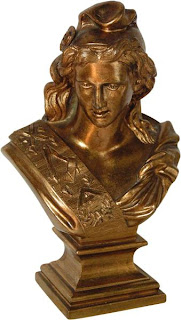
Marianne

Marianne is a national emblem of France and an allegory  of Liberty and Reason.

She represents the state and values of France;liberty, equality and fraternity.                 

She symbolises the Triumph of the Republic.


Her profile stands out on the official seal of the country, is engraved on french euro coins and appears on french postage stamps.


Exist two version about the origins of Marianne,depicted by artist Honoré Daumier,in 1848 or by the sculptor Francois Rude.

The origin of the name : well some believe that the name came from the contraction of Marie and Anne,two names used between the female poblation in that year. Others say that came from the name of the Jesuit Juan de Mariana, the 16th century monarchomach  and Others think it was the image of the wife of the politician Jean Reubell.

The official busts of Marianne initially had anonymous features, appearing as women of the people. From 1969, however, they began to take on the features of famous women, starting with the actress Brigitte Bardot. She was followed by Mireille Mathieu(1978)m Catherine Deneuve (1985), Inés de la Fressange (1989),Laetitia Casta (2000) and Evelyne Thomas (2003). 


Wednesday, July 4, 2012

French National Clothing

Because France is divided into many different regions there is actually no national dress. Each French region has their own traditional dress and they are very different from each other; it seems, that the only thing they have in common is that men wear pants, women skirts and both wear hats of different styles. Nowadays, traditional regional costumes are just worn at festivals and celebrations. In Alsace, women may be seen in white, lace-trimmed blouses and aprons decorated with colorful flowers. Women's costumes in Normandy include white, flared bonnets and dresses with wide, elbow-length sleeves.
Regional costumes are based on late 19th century rural clothing. It is difficult to describe a traditional national dress because as we told you later there is no such thing, however the majority of them include the following garments:


Men: It is believed that their clothes were similar to those of the Indians.
Chemise: A knee length cotton or linen shirt, considered to be an undergarment

Culottes or Breech cloth: A pair of knee length pants, usually wool or linen, which button around the knees, or a cloth worn over the loins.
Hose:  A pair of cotton or wool socks, knee high
Mitasses: A pair of protective garters worn over the lower legs, made of leather or wool, which button to the breeches or tie to a belt.
Guillette: Small short vest usually without sleeves, worn over the Chemise.Capote or Justacorp: Heavy coat with large cuffs worn over all else, kind of like a suit coat.


Women:  Without exception they all wear caps, while their skirts are scarcely down the middle of their legs. Their shoes are often like those of the Finnish women, but are sometimes provided with heels.  They have a silver cross hanging down the breast
Jupon: A garment very similar to a skirt, only shorter. Many of these could be worn at once to show wealth and status.
Chemise: An underskirt or shift worn under all of the outer petticoats and the jupon.
Mantelet: A short women's waistcoat, worn with the jupon and chemise.
Fichu: A square or oblong piece of cloth used by women as a modesty scarf worn about the neck and shoulders


French cock

The cock, is the national animal of France.That means a fighter that always win.

French people say that it is a masonry symbol, as some persons know that France was the birthplace of "francmasons", society that was involucrated in the fall of the monarchy in the french revolution of 1789.After that , the cock was adopted like the national animal.

In the middle age the cock was used like a religious symbol, hope sign and faith.

Also some persons say that the rooster refers to the colors of the flag because the white chest ,red tail and blue feets.

In  1998 the famous FIFA world cup was the hosted by France, they used the rooster like their pet and it was named "Footix".


Now it is used to represent France most in some sports like football (soccer).


Monday, July 2, 2012

F.F.F.F: FRENCH FLAG FUN FACTS !


As you might have noticed the French flag has 3 vertical color bands (from left to right): blue, white and red.  The colors allude to the first French Tricouleur flag.  During the French Revolution white, was teamed with the colors of the French militia, blue and red, to form the tricolor army which would represent France for the years to come. Members of the Parisian militia which stormed the Bastille on July 14, 1789 had worn blue and red cockades on their hats. To provide the blue and the red a national appeal, Marquis de La Fayette, the French leader suggested including a white cockade to the uniform of the National Guard.
 According to Ancient and Heraldic traditions the colors have the following meaning:
-          White: Honesty and peace
-          Red: bravery, strength ,hardiness and self -assurance
-          Blue: truth, loyalty, perseverance, justice and vigilance
Did you know that…
-          Prior to the French Revolution, France had traditionally been represented by the plain white flag - a sign of purity and strength!
-          The French tricolor flag was officially adopted on February 15, 1794.
-          The French flag was designed by Jacques-Louis David; however not everyone agrees with this
-          On July 14 1790 The Champ the Mars, a large grassy field near the Eiffel Tower, was festooned with tricolor flags to celebrate the federation and this is how it became the symbol of the nation. [As you may have noticed this day matches the Day of the Bastille. Just to remember the Bastille was stormed on July 14 1789]
-          In 1790 the flag was actually red, white, and blue and by 1794 the current form (blue, white, and red) was approved
-          The naval ensign of France has the same colors but with a different aspect ratio.

Flag Terminology Curious facts!
-          The design and description uses specific flag terminology based on Heraldic principles
-          Animal blazons should always appear with the heads facing the flag - staff side
Flag France animated gif 240x180-          The Study of the Flags is called Vexillology and therefore if you are interested in flags you are a Vexillologist!
-          Hoist:  the act or function of raising the French flag, as on a rope
-          Distress:  is denoted by flying the French flag upside-down
-          The French flag should be hoisted briskly and lowered ceremoniously
-          The French flag (as many other flags) should never be allowed to drag along the ground
-          A Flag of French, when is no longer in use or looks mistreated, should be destroyed in a dignified way, preferably by burning it in private with all due care and respect

Did you know that...?

We are going to present you some facts that maybe you didn´t know about France.

In 2011 Durex Global Sex Survey found that France has the people who have sex most often in the year.

According to the WHO (2008) , french men have the lowest incidence of obesity.

French are the biggest consumers of psychotropic drugs.

There are between 5 and 6 million of more or less seriously handicaped people in France.This includes physical, sensorial and mental handicaps.

In 2011 a study revealed that french people are the biggest consumers of medicines in Europe.
French people are the second  biggest consumers of alcohol per capita in the Western world.

André Gide, french writer and Nobel Prize of  Literature , said "French people are Italian people in bad mood".

Until 1964 french women were not allowed to open a bank account or get a passport without their husband´s permission.

There are some 40,000 chateaux(castles, palaces...) in France.

France is the country that has won the most Nobel Prizes for literature .

There are over 300 kinds of cheese.

There are about two new cooking books published every day in France.

Framous french invention include the adding machine, hot air ballon , the airship,the parachute, the submarine,photography, animation and cinema.

French is the  the second most commonly taught foreign language, after English.

France created the first universal declaration of human rights in 1789.

The most popular sports in France are football (soccer), rugby league and rugby union.

Interesting right? We hope that you enjoyed it . Have a nice day :) :)

Monday, June 25, 2012

The Palace of Versailles

Although the most classical place to visit while traveling to France is the Eiffel Tower we will like to offer you another excellent choice: The Palace of Versailles. According to an international tourism webpage this wonderful place scored the 4th place of the 10 “Most Beautiful Places in the World”
The Palace of Versailles is the most famous palace in France, not only as a building, but as a symbol of the system of absolute monarchy. This ancient building was built in 1624 in the mandate of Louis XIII; it was originally a hunting lodge. Louis XIV (Louis thirteen´s successor), expanded the place and at that time it was considered one of the largest palaces in the world!
 This might have sound really nice, however not everything was like that. Louis XIV didn´t expand the place just for France to look beautiful, on the contrary, he used the palace to control France by absolute rule. The Palace of Versailles was the official King´s residence from 1682 until October 1789 when the royal family was forced to return to Paris during the French Revolution. 
Nowadays this palace is a charming museum…..
The Fifth Republic promoted the museum as one of France´s foremost tourist attractions although it still keeps some political functions.  Heads of State, the Senate and the National Assemble meet in Hall of Mirrors in order to revise the French Constitution as a tradition that was established with the promulgation of the 1875 Constitution.  
There are different exhibitions shown in The Palace of Versailles and these are constantly changing. If you have the desire to visit the palace, expect a lot of elegance and luxury, since this was a royal residence. The price of the ticket is €15 and it includes the exhibitions and all of the most famous places such as: the Hall of Mirrors, Grand Apartments of the King and of the Queen, King's Bedchamber etc.
Because of its big size The Palace of Versailles opens certain sections on certain days:

Palace
Every day except Mondays
9 am - 6.30 pm
Last admission: 6 pm - Ticket office closes at 5.50 pm

Trianon Palaces and Marie-Antoinette's Estate

Every day except Mondays
12 pm - 6.30 pm
Last admission: 6 pm - Ticket office closes at 5.50 pm

Garden
Open every day
8 am - 8:30 pm

Park

Open every day
7 am - 7 pm for vehicles; 7 am - 8.30 pm for pedestrians

Official Webpage http://www.chateauversailles.fr/homepage

La Marseillaise

Well , maybe you know that "La Marseillaise" is the nathional anthem of France or maybe not.If you don´t know we are going to present you just a little bit of history.

The song, originally titled "Chant de guerre pour l'Armée du Rhin"(War song for the Army of the Rhine). Was written and composed by Claude Joseph Rpuget de Lisle  in 1792.

The song is the first example of the "European march" anthemic style. The anthem's evocative melody and lyrics have led to its widespread use as a song of revolution and its incorporation into many pieces of classical and popular music.

The song's lyrics reflect the invasion of France by foreign armies(from Prussia and Austria) that were underway when it was written. The lyric also criticize their own town .

During the first republic , La Marseillaise was a popular anthem between soldiers and civils.Then in the time of the two Empires was forget it. Then in the third republic was interpreted by military bands in official acts.

Then in october 4 0f 1958 was recognized like National Anthem.

"La Marseillaise" was arranged for soprano, chorus and orchestra by Hector Berlioz  in about 1830.

 Franz Liszt wrote a piano transcription of the anthem.

 Serge Gainsbourg  made a reggae version in 1978, titled "Aux Armes, Et Caetera".
 
In Peru and Chile,  the Paetido Aprista Peruano and the Socialist Party wrote their own versions of "La Marseillaise" to be their anthems.

Nowadays France only sing the first verse and the chorus , sometimes the sixth and seventh verse.

Wednesday, June 20, 2012

A bit of humor:

The French humor is considered less nonsensical than the English humor; however it is crueler. It is known that the French people are excellent teasers which contribute to the well-known stereotype that says French are rude. Ethnic jokes are common in France and they are about Belgians and Southerners.  Their humor includes excessive exaggerations about falsehood which might be very difficult for foreigners to understand, they also love jokes about sex and body functions. Puns are very common among the French because they are really fond about their language however you must be a master in the language to understand them.
 

Here we include some French jokes:


Toto et la conjugaison

La maîtresse demande à Toto: 

- Conjugue-moi le verbe savoir à tous les temps. 

- Je sais qu'il pleut, je sais qu'il fera beau, je sais qu'il neigeait. 

 The teacher asks Toto:
- Conjugate the verb ‘savoir’ (to know) in all tenses.
- I know that it’s raining, I know that it will be nice out, I know that it was snowing. 
The word "temps" refers to verb tenses as well as the weather.

Toto is a recurrent name in the French jokes field: he is a young school boy, mischievious and often vulgar, who gets into all sorts of troubles.


Evelyne est historique

- Philippe dit à son copain: 

- Chaque fois que je me dispute avec Evelyne, c'est simple, elle devient historique!  

- Heu... tu veux dire hystérique? 

- Non, non, historique! Elle se souvient alors de tout ce que j'ai fait de travers, du jour et de l'heure!
Philipe is telling his friend:
- Every time I argue with Evelyn, she simply becomes historic!
- Oh, you mean hysteric?
- No, no, historic! She remembers all my wrongdoings, [even the very] day and hour!

Nom d'une pomme!

- Une pomme qui est rouge, jaune, et verte. Comment l'appelle-t-on ?

- On la pèle avec un couteau.
- An apple which is red, yellow, and green, what would we call (appeler) it?
- We peel (pèle) it with a knife!
Note: There is an audible pun at work here. When spoken, “l’appelle-t-on” [… we call it] could be mistaken for “la pèle-t-on” [… we peel it]).